


When a tooth needs to come out, can an implant be placed at the same appointment? In some cases, yes. This is called immediate implant placement.
However, it is not right for every tooth or patient. The socket, available bone, infection, gum tissue, health history, bite, and final restoration all influence the decision. An evaluation before extraction helps your oral surgeon and restorative dentist plan the appropriate sequence.
At Northwest Oral Surgeons in O’Fallon, MO, we coordinate the surgical plan with the dentist who will provide your replacement tooth.
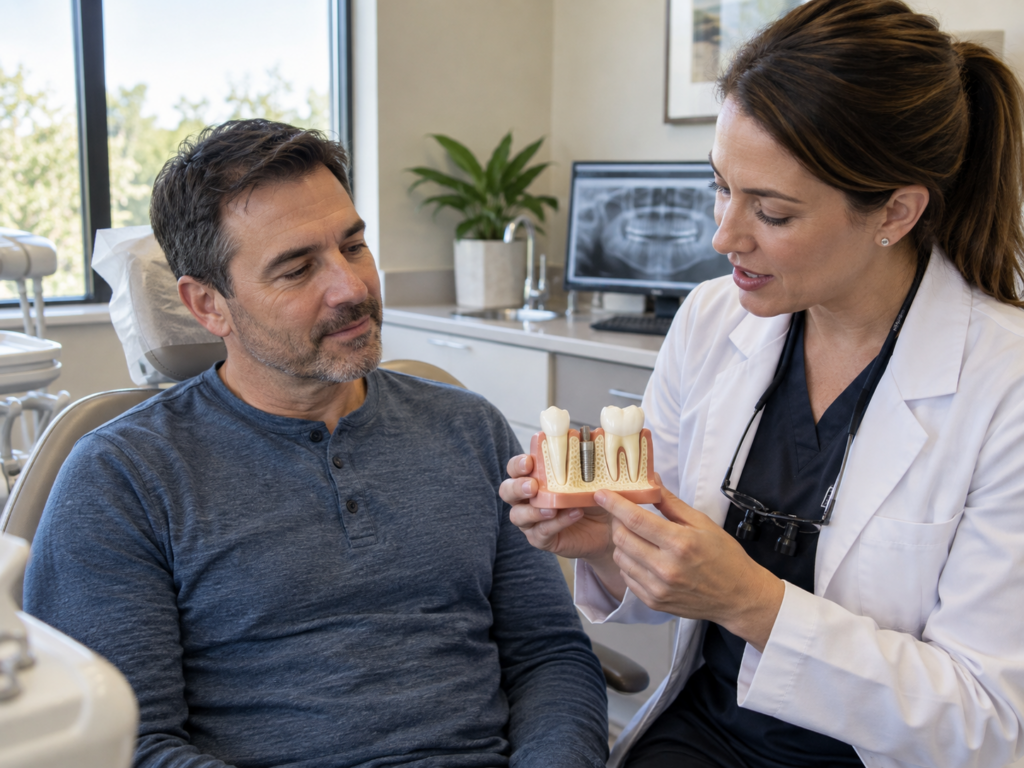
What Is an Immediate Dental Implant After Extraction?
An immediate dental implant after extraction is placed during the same procedure in which the damaged or failing tooth is removed. After the extraction, the surgeon examines and cleans the socket. If the remaining bone and surrounding tissue can support the treatment plan, the implant may be positioned during that appointment.
With delayed implant placement, the extraction site heals before the implant is placed. A patient may also need socket preservation or another bone-grafting procedure first. The goal is to choose timing that gives the implant appropriate support and position for the planned replacement tooth.
Immediate Placement Is Not the Same as Same-Day Teeth
The terms “immediate implant” and “same-day tooth” are sometimes used as though they mean the same thing, but they describe different steps.
- Immediate implant placement means the implant is inserted during the extraction procedure.
- Immediate restoration means a tooth or prosthesis is attached within the first week after placement but kept out of contact with the opposing teeth.
- Immediate loading means the restoration is attached within the first week and contacts the opposing teeth during biting.
- The final restoration is the long-term crown, bridge, denture, or full-arch prosthesis. It is generally completed after sufficient healing.
Immediate restoration or loading may occur on the surgery day in selected cases. Neither is automatic simply because the implant was placed immediately.
Some patients may wear a temporary tooth during healing. It must not place harmful pressure on the surgical site. The restorative dentist generally manages the temporary and final teeth, while the oral surgeon performs surgery and monitors healing.
What Determines Whether an Implant Can Be Placed Right Away?
We recommend a sequence after an examination, health-history review, and appropriate imaging.
The Condition of the Extraction Socket
We evaluate the socket walls and available bone in the planned implant position. A damaged socket does not automatically rule out an implant, but it may require grafting and a different sequence.
Initial Implant Stability
An implant needs enough support to remain stable while healing begins. If appropriate stability cannot be achieved in a position that supports the future restoration, the site may need to heal first.
Stability also affects whether a temporary tooth can be attached. An implant may be placed immediately but left unloaded while it heals.
Infection and Tissue Health
The diagnosis, extent of inflammation, bone condition, and ability to clean the site thoroughly all matter. Immediate placement may be considered for selected sites with chronic infection after thorough cleaning and evaluation. Other sites are better treated with extraction, infection control, grafting when appropriate, and healing first.
Bone Quantity, Quality, and Nearby Anatomy
We assess bone quantity and quality along with nearby tooth roots, nerves, and the sinus. CBCT or other imaging may be recommended for planning. Bone loss does not always prevent treatment, but it may change the position, timing, or need for site development.
The Final Restorative Plan
Implant planning begins with the final tooth in mind. A site may require a different approach if immediate placement would compromise the bite, appearance, cleaning access, or restorative design.
Health and Healing Factors
Health history, medications, nicotine use, diabetes management, previous radiation, immune conditions, and osteoporosis treatment can affect planning and healing. Share a complete medication list and recent health changes. Do not stop prescribed medication unless the appropriate clinician gives you instructions.
What Happens During Extraction and Immediate Implant Placement?
The exact steps vary, but a coordinated visit may include:
- Reviewing the surgical, anesthesia, and restorative plans.
- Completing the tooth extraction while preserving useful bone and tissue when possible.
- Cleaning and examining the extraction site.
- Confirming whether the site matches the conditions expected from the examination and imaging.
- Placing the implant in a position that supports the replacement tooth if adequate stability can be achieved.
- Adding graft material when it is useful for the specific site.
- Placing a healing component or closing the tissue over the implant.
- Providing instructions for diet, hygiene, activity, medication, and follow-up.
The final decision may be made during surgery because direct examination can reveal details that imaging cannot fully predict. The plan should include an alternative if the site cannot support immediate placement.
Will You Need a Bone Graft?
Not every patient needs bone grafting for dental implants. When an immediate implant is placed, graft material may be used to support the contours of the extraction site or address space between the implant and parts of the socket. In other cases, the better approach may be to remove the tooth, perform socket preservation, allow the area to heal, and place the implant later.
Socket preservation can help maintain the ridge for future treatment, but it does not create an instant implant site or guarantee that no additional grafting will be needed. The recommendation depends on the anatomy and the restorative goal.
When Is Delayed Implant Placement a Better Choice?
Immediate placement is convenient when the conditions support it, but speed should not override sound surgical planning. A healing period may be recommended when:
- The implant cannot be stabilized in the correct position
- The socket has significant damage or bone loss
- Infection or inflammation requires staged management
- Bone grafting or soft-tissue preparation should heal first
- The restorative plan is not yet complete
- Health factors make a staged approach more appropriate
A staged approach allows the site to heal or receive preparation before implant placement.
What Happens After the Implant Is Placed?
After surgery, bone gradually forms a stable connection around the implant through a process called osseointegration. The length of this phase varies with the implant location, bone quality, grafting, health factors, and pressure placed on the area.
Even if the area begins to feel normal, the implant still needs protection and follow-up. Follow your postoperative instructions for eating, oral hygiene, activity, medications, and any temporary appliance. Do not chew directly on the surgical site or allow a removable temporary tooth to press against it unless your treatment team says it is safe.
Dr. Maryann L. Udy monitors surgical healing and determines when the implant is ready for the restorative phase. Your restorative dentist then designs and delivers the final crown, bridge, denture, or full-arch prosthesis.
Frequently Asked Questions
Can every extracted tooth be replaced with an implant the same day?
No. Immediate placement depends on the condition of the socket, available bone, infection, implant stability, nearby anatomy, health factors, and the restorative plan. Some sites need grafting or healing first.
Can I leave with a tooth on the implant?
Some patients may receive a temporary restoration, but immediate implant placement does not guarantee same-day teeth. The decision depends on implant stability, bite forces, location, restorative design, and whether the temporary can be protected during healing. The final restoration is generally completed later.
Is a bone graft always needed after extraction?
No. Grafting is recommended when it supports the planned implant or another restorative goal. The surgeon evaluates the socket and surrounding bone to determine whether grafting is useful and whether it should be completed during extraction or in a separate stage.
What if the surgeon plans an immediate implant but the socket is not suitable?
Your surgeon should discuss an alternative plan before treatment. If the site does not provide the expected support, the surgeon may perform socket preservation or another grafting procedure and allow the area to heal before implant placement.
Who places the implant and who makes the final tooth?
At Northwest Oral Surgeons, Dr. Udy performs the surgical phase, which may include extraction, grafting, implant placement, and healing follow-up. The restorative dentist generally designs and delivers the temporary restoration when one is used and the final crown, bridge, denture, or full-arch prosthesis.
Plan Before the Tooth Is Removed
If you are considering a dental implant, discuss that goal before the extraction whenever possible. Early coordination helps us and your restorative dentist determine whether immediate placement, socket preservation, or another sequence supports the planned restoration.
At Northwest Oral Surgeons in O’Fallon, MO, we provide tooth extraction, implant placement, bone grafting, and surgical follow-up in coordination with restorative dentists. Dr. Udy is a board-certified oral and maxillofacial surgeon who uses clinical evaluation and technology-supported planning when appropriate.
Call our team to schedule a consultation with Northwest Oral Surgeons and discuss whether an immediate dental implant after extraction may be appropriate for you. Have your medication list, available imaging, referral if applicable, and your dentist’s restorative plan ready.